
NEWS
PoliticsAfrica Is Resource-Rich but Cash-Poor’, Observes Rutten, Unveils CMFC Strategy
By Emmanuel oniyide | 30th Mar 2026 | 5:11 PM
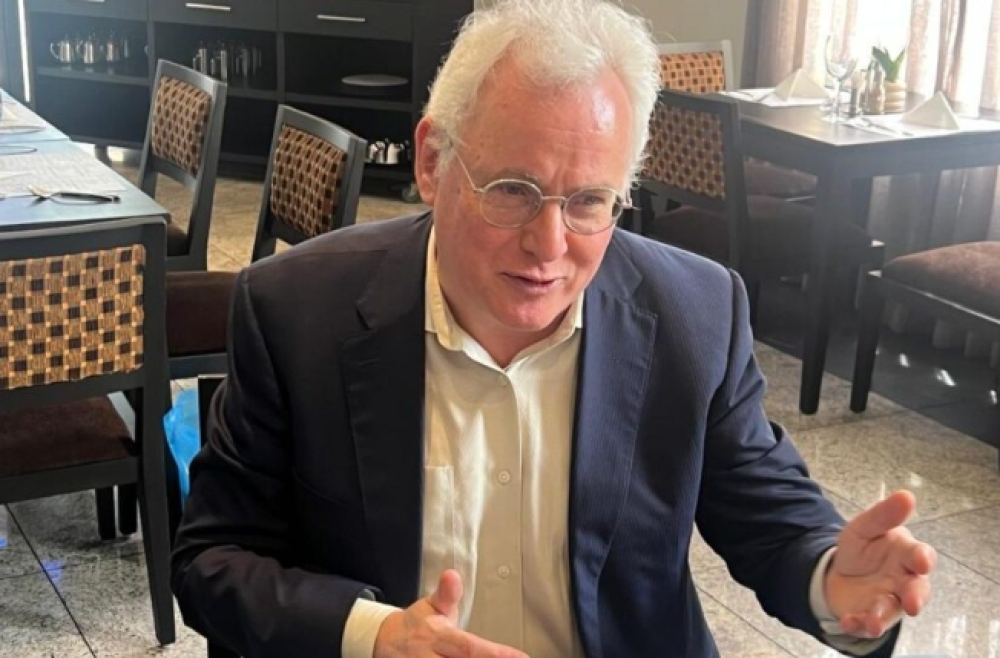

Chairman of the newly rechristened Critical Minerals Financing Corporation (CMFC) Plc, Lamon Rutten, has set out an ambitious roadmap to reposition Nigeria and Africa within the global minerals value chain, emphasising financing, value addition and structural reforms as key levers for transformation.
Speaking in his maiden interview with a select group of senior journalists, Rutten described the continent’s minerals sector as vastly underutilised.
“There is a large underexploited potential in Nigeria’s mineral economy and even more across Africa,” he said. “Today, a lot of ore is exported without processing, meaning most of the value-added leaves the country.”
He stressed that Africa’s resource wealth has not translated into economic prosperity due to weak value chains and limited capital deployment. “Africa boasts of more than 30 per cent of global mineral reserves, but these have remained largely underexplored and undercapitalised. There are no integrated supply chains. And these are the missing links for converting the natural resources into national wealth for all.”
Rutten explained that CMFC’s model is designed to address this structural gap by financing the entire minerals ecosystem, from exploration to downstream trade.
“Critical Minerals Financing Corporation (CMFC) Plc will help develop those value chains — not just extract and export, but use minerals as a foundation for wider development,” he said. “Africa is wealthy in resources but poor in actual money. That gap exists because resources are not being valurised.”
According to him, the company’s financing approach could have significant macroeconomic impact. “If done properly, this could raise Gross Domestic Product (GDP) growth by almost two per cent annually on a sustained basis, not as a one-off. The multiplier effects are significant.”
He added that CMFC’s long-term strategy is to build from Nigeria outward. “Our strategy is to gradually scale up our businesses by exploring immediate deals within the Nigerian minerals sector, and then using the Nigerian experience as a showcase of competence and potential to convince other African economies.”
On operations, Rutten noted that the corporation would deploy capital across upstream, midstream and downstream segments. “So, you have a whole gamut of valurisation of the minerals sector, with profound multiplier effects across the country,” he said.
He described the timing of CMFC’s emergence as critical to Nigeria’s economic agenda. “We are at a point that Nigeria vigorously seeks to push its economic diversification programme. Finance is key in this, finance is the nexus… When we connect finance to the nation’s natural endowments… Nigeria could deepen its economic growth and spread prosperity across the country.”
Addressing sector risks, Rutten identified regulatory uncertainty as a key concern. “When you obtain a licence, you need certainty that a change of government will not invalidate it,” he said, while adding that environmental and price risks can be managed with proper planning.
He maintained, however, that long-term fundamentals remain strong. “For critical minerals, long-term demand will rise faster than supply. Structurally, the long-term outlook is positive.”
Rutten also highlighted Africa’s human capital advantage. “The problem is not competence; it is empowerment and access to capital. We will bring that capital,” he said, adding: “At CMFC, we… have mastered capital, that’s our niche.”
On financing structure, he underscored a shift away from unsecured lending. “In critical minerals, you do not provide unsecured finance. You finance real assets, secured by those assets,” he explained. “Unsecured finance has caused many losses historically. In critical minerals, everything is secured and structured.”
He expressed confidence in CMFC’s financial outlook, citing diversified income streams and risk management frameworks. “We are operating on the basis of multi-commodity diversification, multi-country origination, hedged commodity exposure… and counterparty diversification,” he said. “So, talking about financial outlook, I can assure you that the outlook is bright.”
Rutten also signalled plans to deepen capital market integration. “Ultimately, the goal is to bring this to the capital markets,” he said. “The technology exists to develop public investment products around commodity flows.”
On policy, he urged governments to prioritise stability over incentives. “Incentives are not the key issue. Stability and predictability are. First: no surprises. If you receive a permit, it remains valid,” he said. “Licensing uncertainty, sudden tax changes, and slow bureaucratic processes discourage investment. Those must disappear.”
Despite concerns about capital intensity, Rutten insisted funding is not the main constraint. “There is enough money — even in Nigeria. The issue is trust and structure,” he said, outlining a model that secures financing through assets and monitored revenue flows.
Looking ahead, he refrained from giving numerical projections but expressed optimism about CMFC’s trajectory. “Success would mean implementing the strategy — building structured, secured mineral financing, scaling responsibly, and operating in predictable jurisdictions,” he said.
He pointed to surging global demand as a key tailwind. “The global demand for critical minerals and rare earths is explosive and so the growth opportunities are enormous,” he said, noting that demand could exceed 28 million tonnes by 2040, with energy transition minerals alone projected to surpass $400 billion annually by 2050.
Rutten concluded that CMFC is strategically positioned to capture value across the entire chain. “We are the only private-sector-focused group that provides both equity and credit across mine-to-market value chains,” he said. “So, we can play end-to-end and benefit every step of the process.”




Comment on this Post
Comments (0)