
NEWS
PoliticsIllegal Lithium Mining and Insecurity in Kwara's Kaiama Area
By Emmanuel oniyide | 11th Mar 2026 | 11:57 PM
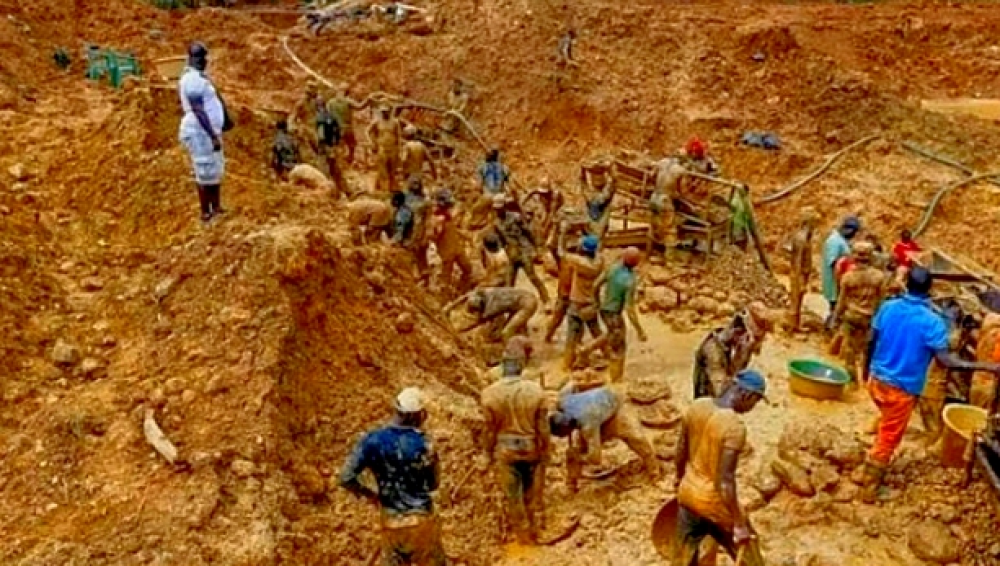

In recent months, Kaiama Local Government Area in Kwara State has experienced a surge in violent attacks, kidnappings, and killings that have destabilised its rural communities. Amidst this climate of insecurity, a parallel economy has emerged: the unregulated extraction of lithium, a mineral critical to the global green energy transition.
This report draws on fieldwork in the region to examine the clandestine mining operations centred on the community of Bani. Once primarily agrarian, Bani has over the past three years become a hub for miners drawn by rising international demand for lithium. The influx has attracted individuals from across Nigeria, particularly from northern states. While early tensions between miners and local transporters occasionally led to conflict, these have since subsided in favour of cooperation. As one miner explained, "fighting will not allow us to get money from buyers."
The extraction and transport network is now well established. Lithium ore, locally referred to as "Konsa," is packed into 50-kilogram bags and moved by truck, typically at night, to collection points in Ogun State, such as Ogere and Sagamu. From there, the minerals are channelled into export markets. A local transport operator, who owns two trucks and requested anonymity, noted that moving a load from Bani to Ogun costs between ₦1.5 million and ₦1.9 million. Each consignment is marked to identify the receiving agent and destination warehouse.
Miners allege the trade persists under the protection of compromised security personnel. According to one operator, payments of ₦20,000 to ₦30,000 per trip secure a "permit" stamped by officers from agencies including the police, NSCDC, customs, or immigration. "With that paper, no security officer on the road will disturb us," he said. The permit is reportedly valid for a single journey.
The Kwara State command of the Nigeria Security and Civil Defence Corps (NSCDC) denied these claims. Spokesman Michael Ayoola stated, "We don’t grant them permits. We don’t have business with illegal miners; we are out to arrest them." However, a senior official within the command, speaking anonymously, acknowledged that miners often offer "appreciation" to officers who facilitate their operations, adding, "I don’t think that is out of place apart from official remuneration."
The trade operates with relative openness. Lithium ore is sold in local markets, and dealers maintain stockpiles sourced from Bani and nearby areas, including sites within the old Oyo National Park. A dealer who spoke on condition of anonymity estimated the revenue loss to government as substantial, noting that lithium fetches over $70,000 per ton, with hundreds of undocumented trucks leaving the state.
The mining economy functions alongside persistent violence. In early February, coordinated attacks in the communities of Woro and Nuku resulted in dozens of fatalities, with local estimates ranging from 78 to more than 160 victims buried in mass graves. Despite this, mining activities continue. Some participants report that armed groups do not directly target them. Driver Kokoma Ahmed, who transports miners regularly, said he was unaware of any attacks on extraction sites. "They do their business unhindered," he said.
Others describe a more ambiguous relationship. Dealer Ibrahim Farouk suggested informal coexistence rather than explicit collusion. "I can’t call it a deal, but they know us and understand the job we do. We don’t disturb them, and we are not their targets." Security sources in the region believe some criminal groups may derive indirect benefit from the trade, either through agents or front operations, mirroring patterns observed in gold mining areas across northern Nigeria and the Sahel.
Local residents report significant environmental and social costs. Farmland has been degraded by excavation, and armed miners have been known to intimidate villagers attempting to protect their land. One farmer described the disruption: "Even when we reach the farm early, once the miners come and start work we cannot farm again."
Community leader Alhaji Mohammed Abdulazeez called for regulation rather than prohibition. "Mineral resources are gifts from God for the development of humanity. The government should properly regulate the sector and provide security so the country can benefit from it."
The situation in Kaiama illustrates the convergence of unregulated resource extraction, weak oversight, and rural instability. As global demand for lithium continues to grow, remote areas like Bani risk becoming nodes in an illicit supply chain that undermines state authority and deepens local insecurity. Without stronger governance and sectoral regulation, the region's mineral wealth may continue to generate profit for some while compounding the vulnerabilities of many.




Comment on this Post
Comments (0)