
NEWS
PoliticsNigeria, US Mining Pact to Create Jobs Through Local Processing, Skills Development
By Emmanuel Oluwafemi Oniyide | 25th Sep 2026 | 1:22 PM
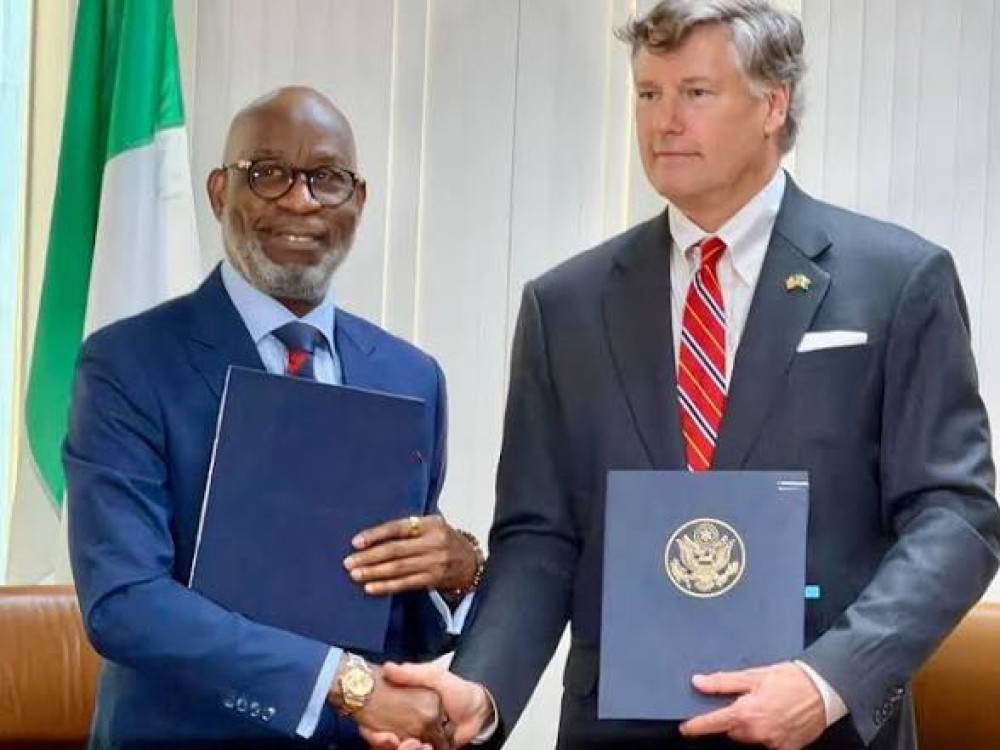

Nigeria and the United States have signed a framework agreement to deepen American investment in Nigeria’s mining sector and unlock the country’s estimated $700 billion mineral resources, with both governments framing the deal as a vehicle for job creation, skills development and industrial growth.
Minister of Solid Minerals Development Dele Alake and U.S. Deputy Secretary of State Christopher Landau signed and exchanged the agreement on Wednesday at Nigeria’s Mission House in New York, on the sidelines of the 81st United Nations General Assembly.
At the heart of the agreement is Nigeria’s push to move away from exporting raw minerals and retain greater economic value at home. Alake said the framework is designed to promote local processing, technical skills and quality jobs for Nigerians.
“Our goal is to turn potential into lasting value at home through stronger local processing, new skills, quality jobs, and new opportunities for Nigerian businesses,” Alake said. He added: “Nigeria cannot remain a source of raw materials while others capture most of the value. We want more local processing, quality jobs, stronger skills and greater opportunities for Nigerian businesses.”
The agreement covers geological data and exploration, mineral development and processing, infrastructure, and technical capacity building. It is designed to use the Nigeria-U.S. government relationship as a foundation for business-to-business transactions and greater investment across Nigeria’s mineral value chain.
Implementation is expected to support the economic diversification objectives of President Bola Tinubu’s Renewed Hope Agenda and boost industrial growth. Tinubu has said Nigeria’s mineral wealth must translate into jobs, thriving local businesses and improved livelihoods for Nigerians, adding that “our geologists, engineers and technicians must find work.”
Landau described Nigeria as Africa’s fastest-growing economy and most populous country, saying the United States views Nigeria as a regional power and an important partner.
“The signal we are sending is that the United States and Nigeria are partners,” Landau said. “Under President Trump and President Tinubu’s leadership, the United States and Nigeria have done many things together in the last one and a half years that we’ve never done before. I think we would like to keep building on that momentum.”
The deal comes amid growing competition between the United States and China for access to Africa’s critical minerals, as Washington seeks to diversify supply chains for minerals used in electric vehicles, renewable energy and defence technologies. Chinese companies have been among the most active foreign investors in Nigeria’s emerging lithium industry.
Nigeria’s solid minerals sector has already attracted over $2.6 billion in foreign direct investment into midstream processing ventures, driven by a strict value-addition policy that requires processing and refining to take place locally before export approvals are granted. The sector’s contribution to GDP has climbed from a historical average of less than 0.5% to 1.8%, with revenue rising from ₦16 billion in 2023 to over ₦70 billion projected for 2026.
Flagship projects already demonstrating the jobs potential include a lithium processing plant in Nasarawa State expected to create 10,000 direct and indirect jobs, and a $200 million lithium processing plant in Zamfara State targeting 2,000 jobs.
Alake said the focus would now shift from signing the agreement to implementing concrete projects. “A signature is a promise, results are the proof,” he said. “In the coming months, we will identify viable projects, mobilise investments and build the commercial partnerships that deliver measurable benefits to our nations.”
Also present at the signing were Lagos State Governor Babajide Sanwo-Olu; Permanent Secretary, Ministry of Solid Minerals Development, Yusuf Yabo; Director-General, Nigerian Mining Cadastral Office, Simon Nkom; Executive Secretary, Solid Minerals Development Fund, Fatima Shinkafi; and Chief Executive Officer, Nigeria Solid Minerals Company, Martin Imonitie.
The U.S. delegation included Deputy Assistant Secretary for West African Affairs Rich Michaels; Acting Deputy Assistant Secretary for Southern Africa, Foreign Assistance and Critical Minerals, Chris Kulukundis; Senior Policy Adviser to the Deputy Secretary, Wyatt Toehlkeke; and Jitu Sardar.




Comment on this Post
Comments (0)