
NEWS
PoliticsAkume tasks panel on professionalism as FG reviews $200bn gas-power-rail proposal
By Emmanuel Oniyide | 10th Apr 2026 | 9:04 AM
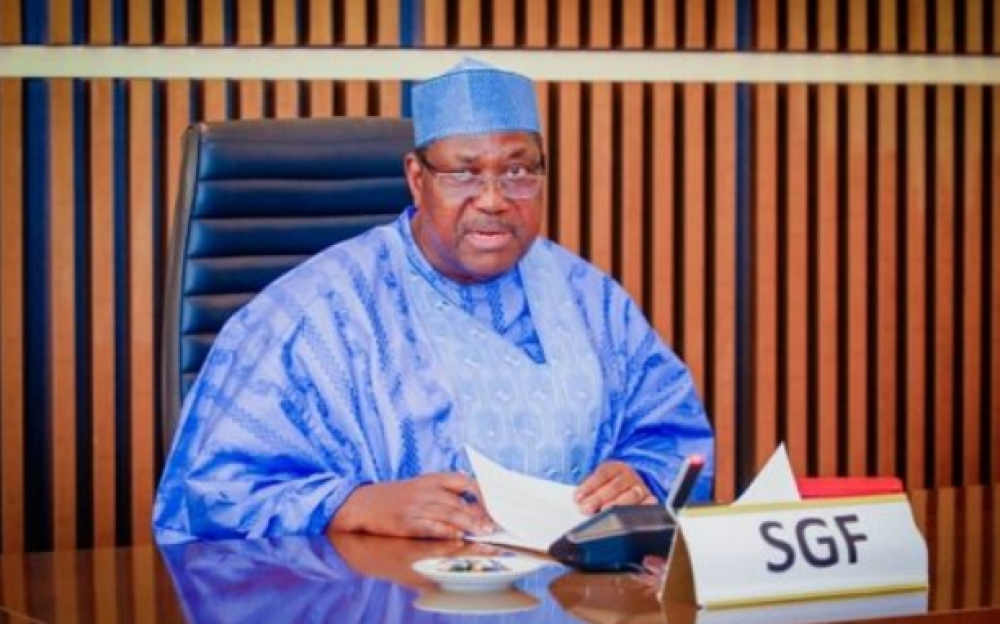

The Secretary to the Government of the Federation (SGF), Senator George Akume, has charged members of the Federal Government's Technical Committee reviewing the proposed $200 billion Integrated Gas, Power, and High-Speed Rail Project to approach their assignment with the highest level of professionalism, objectivity, and patriotism.
Akume said the committee's collective expertise and institutional knowledge would be critical in ensuring that the government receives recommendations capable of guiding appropriate decisions in the national interest.
He gave the charge on Thursday in Abuja while inaugurating the inter-agency committee constituted to assess the proposal submitted by De-Sadel (Nig.) Limited, in partnership with China Liancai Petroleum Investment Holdings Limited (Liancai Group), for the development of the massive infrastructure project.
"I therefore urge you to approach this assignment with the highest level of professionalism, objectivity, and patriotism. Your collective expertise and institutional knowledge will be critical in ensuring that the Federal Government receives relevant recommendations that will guide appropriate decisions at the highest level," Akume said.
The SGF explained that the proposed project, estimated at $200 billion, is designed as a multi-phase programme integrating gas development, power generation and transmission, alongside the construction of a 4,000-kilometre high-speed rail network linking major economic corridors including Lagos, Abuja, Kaduna, Kano and Port Harcourt.
According to him, the initiative has the potential to transform Nigeria's transport infrastructure, strengthen energy security, stimulate industrial growth, and deepen national integration.
Akume stressed that projects of such magnitude must undergo rigorous scrutiny to ensure alignment with national priorities, technical soundness, financial viability, and compliance with Nigeria's legal and regulatory frameworks.
He disclosed that the Office of the SGF had already received correspondence and inputs from security, financial intelligence, and regulatory agencies regarding aspects of the proposal, particularly its financing arrangements, participating entities, and related matters. The SGF said those observations underscored the need for a coordinated and thorough technical review before any further government action.
The committee, chaired by the Permanent Secretary, Political and Economic Affairs Office in the SGF's office, draws membership from key ministries, departments, and agencies, including the Ministries of Transportation, Petroleum Resources, Finance, Justice, and Environment. Others are the Infrastructure Concession Regulatory Commission (ICRC), Nigerian Electricity Regulatory Commission (NERC), Nigerian Communications Commission (NCC), Central Bank of Nigeria (CBN), Nigerian Financial Intelligence Unit (NFIU), Economic and Financial Crimes Commission (EFCC), National Intelligence Agency (NIA), Office of the National Security Adviser (ONSA), Department of State Services (DSS), Debt Management Office (DMO), and the Nigeria Governors' Forum Secretariat.
Akume outlined the committee's terms of reference to include verification of financial documents and proof of funds submitted by De-Sadel and its partners; validation of funding commitments; assessment of sovereign and contingent liability risks to the government; and review of the integrated oil and gas-rail financing model.
The panel is also expected to evaluate the technical competence and delivery capacity of the Chinese partners and EPC contractors, examine rail infrastructure plans, assess local content provisions, review regulatory and Public-Private Partnership compliance, and identify security, intelligence, and reputational risks.
It is further mandated to advise the SGF and Minister of Transportation on readiness for presidential briefing and recommend next steps towards Final Business Case submission and Federal Executive Council approval.
Managing Director of De-Sadel Consortium, Samuel Ukoh, while presenting an overview of the proposal, said the project represents a new infrastructure foundation for Nigeria. Ukoh said the full project includes a 4,000-kilometre high-speed rail network across the 36 states and the Federal Capital Territory, backed by power generation, gas development, digital fibre optic infrastructure, and real estate developments around mega rail stations.
He said the first phase of the project would focus on a 1,700-kilometre corridor linking Abuja, Lagos, Kano, and Port Harcourt, describing the route as critical for ensuring an early return on investment. According to him, trains on the proposed line are expected to run at speeds of about 350 kilometres per hour, cutting travel time between Lagos and Abuja to approximately two hours and 30 minutes.
Ukoh added that the first phase would also include about 3,500 megawatts of power generation needed to drive the high-speed rail system, while the overall project is projected to deliver 8,500 megawatts.
He said the consortium is proposing an elevated bridge design for the rail infrastructure, arguing that it is better suited to Nigeria's terrain and weather conditions. The bridge system, he explained, would also support transmission infrastructure for electricity and fibre optics, enabling simultaneous deployment of power and digital connectivity along the rail corridors.
Ukoh further emphasised the importance of gas to the project, noting that Nigeria's abundant gas reserves provide the raw material needed for power generation that would sustain the rail operations.
At the end of the inauguration, Akume formally declared the committee constituted and expressed the expectation that members would work diligently to submit their report within the timeframe to be communicated by the secretariat.




Comment on this Post
Comments (0)