
NEWS
PoliticsRainbow Rare Earths Advances Phalaborwa DFS
By Emmanuel Oluwafemi Oniyide | 2nd Jul 2026 | 8:51 AM

LSE-listed Rainbow Rare Earths has moved three-quarters of the process flowsheet for its Phalaborwa rare earths project in Limpopo into the engineering phase of the definitive feasibility study (DFS), following successful pilot plant operations through the first half of 2026.
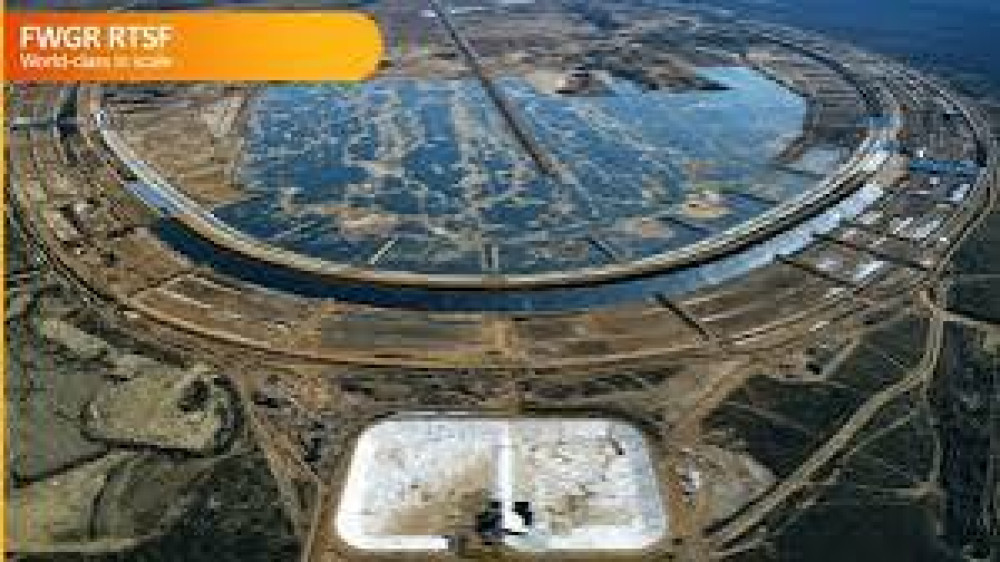
The company is developing what will be the world's first commercial recovery of rare earth elements from phosphogypsum – a waste product from phosphoric acid production stored in enormous stacks near Phalaborwa's central business district, on the border of the Kruger National Park. Because the project recovers metals from existing waste rather than through conventional mining, many of the costs, risks and long timelines associated with traditional mining projects are eliminated.
Rainbow has made significant changes to simplify the project design since its preliminary economic assessment. The company replaced hydraulic reclamation with mechanical reclamation, eliminated the weak acid leach circuit, cut the counter-current leach from three stages to two, and reduced residence time from 32 hours to 8 hours. The number of capital-intensive horizontal belt filters has been reduced from 14 to 8. The company also replaced continuous ion chromatography with solvent extraction, which it described as a proven industry-standard separation process.
The continuous ion exchange circuit achieves a ninefold concentration in rare earth elements, reducing flow from roughly 300 cubic metres per hour as pregnant leach solution to less than 40 cubic metres per hour for impurity reduction, and less than 5 cubic metres per hour into the separation circuit.
"By establishing our own dedicated metallurgical and analytical laboratory in Johannesburg, Rainbow has been able to complete major testwork to optimise capital and operating costs for the Phalaborwa process while simplifying the flowsheet and improving operability," CEO George Bennett said.
Technical director Dave Dodd said Rainbow had "successfully finalised the flowsheet to the point that it delivers a mixed rare earth feed to the SX separation process".
The final solvent extraction circuit is expected to produce neodymium-praseodymium oxide and samarium, europium and gadolinium at 99.5% purity, alongside commercial quantities of dysprosium, terbium and yttrium. These critical minerals are used in electric vehicles, wind turbines and defence technologies.
"Our focus now is on integrating the [solvent extraction] circuit into the overall process and we look forward to further updates in due course which will demonstrate that Phalaborwa continues to represent a near-term producer of light and heavy rare earths, right at the bottom of the industry cost curve," Bennett said.





Comment on this Post
Comments (0)